

Rethink your pets
Or at least what you feed them
I hadn’t given much thought to the climate impact of pets until I saw an article on it the other day. It turns out that pets, dogs and cats in particular, can have a measureable impact on climate (some people estimate it’s comparable to air travel). So if you’re thinking about getting a pet you might want to consider their carbon footprint before making a commitment.
The type of pet matters
Before we go on, I want to be clear that I am in no way advocating for you to give up your pets if you already have them. But if you’re thinking of adding a fluffy addition to your family, these are good things to consider.
Cats and dogs: The issue with traditional pets like these isn’t that they release methane themselves, like cows and sheep do.1 But as carnivores (cats) and omnivores (dogs),2 our pets eat a lot of meat. When the livestock they consume was alive, they produced plenty of methane, giving our pets surprisingly large carbon footprints. This is especially true with the current “raw” trend that involves feeding pets human-grade meat.
Other pets, such as rabbits, hamsters, guinea pigs, turtles and many lizards, are both smaller (so eat less) and have more (or entirely) vegetarian diets. The carbon footprint for these pets is minuscule in comparison to a dog or cat.
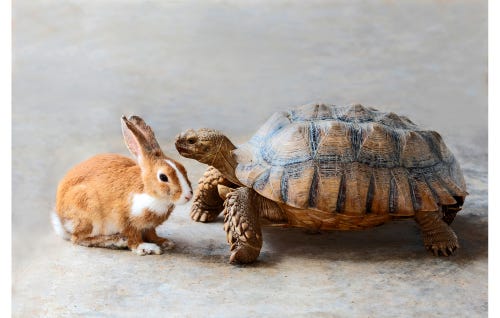
Time to switch out their food?
Already have dogs and/or cats? You might want to consider changing what you feed them. The majority of cat owners feed their pets wet food. Dog owners do so less, but still enough to have an impact. That choice—to give wet food instead of dry—matters. One study found that the carbon footprint for wet food is almost eight times higher than that for dry kibble.3 For a Dachshund-sized dog, an all-wet-food diet corresponds to 14,400 pounds (6,541 kg) of carbon emissions.4 That’s a HUGE impact, particularly when you consider most dogs are larger than Dachshunds and, obviously, eat more.5

Chicken has a lower carbon footprint than beef, so switching to a chicken-based food is a good option. Another is to find foods made from non-traditional proteins, and there’s a move to create more options in this area. These foods might rely on insect protein (often crickets)6 or use fermentation with brewer’s yeast for a vegan option.7
However you decide to approach it, these changes can have a big impact. With nearly two out of three U.S. households home to pets and billions of pets worldwide,8 this is one that can make a real difference.

If you like One Simple Thing, please forward to a friend who might be interested in taking steps toward a healthier planet.
Methane is a powerful greenhouse gas, with 80 times more heating power than carbon dioxide. https://research.unl.edu/blog/nebraska-joins-global-initiative-to-reduce-methane-from-livestock/
Dogs have a bigger impact than cats, even though their diets often contain a lower percentage of meat than cats. That’s simply due to their size and the amount of food they require.
Pedrinelli et al. Environmental impact of diets for dogs and cats. Nature. November 17, 2022
Peter Alexander. How cats and dogs affect the climate – and what you can do about it. The Conversation. June 5, 2023.
The average dog weighs a little more than double the average Dachshund, so you can double that number and throw in a few hundred pounds for good measure.
David S. Gardener. Insect protein: dish of the day for your environmentally friendly pet. The Conversation. January 31, 2019.
Donna Berry. The scientific future of pet food: Leveraging alternative proteins. Pet Food Processing. June 27, 2024.
Peter Alexnader, June 5, 2023.
Yeah, most people don’t think about that. Hubby has been grousing about it for a couple of decades now…that’s life with a climatologist for ya 😬
And don't get me started on those who choose to spend tons of wasteful dollars to buy a trendy 'doodle,' when there are so many animals in need of rescue from shelters and fosters.