

Let nature run its course
Don’t worry—your plants will recover!
This one may be easier said than done, but give it a try. If you have a yard, garden, or even containers on a balcony, try to let nature run its course. What do I mean by that? When you find insects eating your plants, leave them. If you have a diverse assortment of plants, natural predators will be in the area, and they will help keep pests in check. They won’t eat every last one—but see if you can tolerate the damage. And watch to see what happens; it can be fascinating.
Why allow damage?
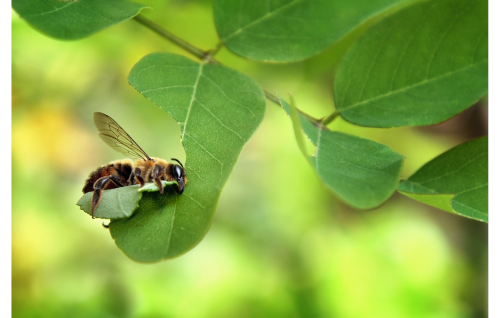
Remember that everything needs to eat. If you see holes in your plants (the most obvious form of damage), there’s a good chance they were caused by some form of caterpillar. (If they’re almost perfect circles, they were made by leafcutter bees—pictured below) If you’re trying to support pollinators, you have to provide food for adults AND their young. That means caterpillars need to eat, too. They eat more as they grow, mowing down foliage with an audible crunch, but they eventually reach a point at which they finish growing and pupate.
The damage is likely to last only a couple of weeks, and plants that evolved with the critters that eat them can take it. They’ll even bounce back stronger and healthier when they recover. (Really!)
Predators will come
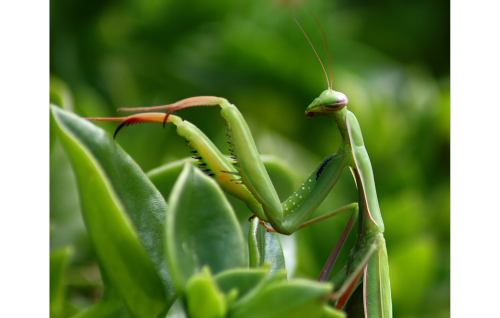
You may well picture a lion or a wolf when you think of a predator, but the invertebrate world is full of them. Piercing mouthparts, vice-like legs, incredible aerial antics to snatch insects out of the air.1 If there’s prey in the area, predators will show up on the scene to feast—or lay eggs so their larvae can eat in a day or two. The outdoors is one big ecosystem, and these dynamics play out all the time, even on something as small as a single potted plant.
When we first started planting native plants at our home, an outbreak of broom moth caterpillars stripped all of the mountain golden banner of their leaves. Since most of the rest of our yard was turfgrass at the time, we didn’t have a wide diversity of predators in the area. This year, we had another outbreak. But the golden banner were patrolled by wasps that helped remove many of the caterpillars. Enough caterpillars survived to keep the population going (that’s a good thing), but the rest became food for wasp larvae. (Wasps can sting, but unless you’re dealing with a social wasp like yellowjackets, tolerate them. They’re important predators and the sign of a healthy ecosystem.)
Just can’t stand it?
If you just can’t bear to watch your garden turn to Swiss cheese, stop before you reach for a spray. Pesticides (no matter what they say on the label) don’t target one kind of pest—they are broad-spectrum products that harm not only beneficial insects (which is 99.9% of them!), but also pets, wildlife, and people. They often work by affecting the nervous system. Recent evidence links them to Parkinson’s Disease.2
If you have a big outbreak of caterpillars, pick them off and drop them into a bucket of soapy water. Bigger outbreak? Talk with a specialist about how to tackle the problem as safely as possible. And plant a wider variety of native plants in your yard—they’ll boost that predator population, so this won’t be as much of an issue in the future.
But remember: plants have always been food for other things (including us). If they’re healthy, they can take the damage and recover just fine.

If you like One Simple Thing, please forward to a friend who might be interested in taking steps toward a healthier planet.
Assassin bug (among others!), preying mantis, and dragonfly, respectively.
Vellingiri et al. 2022. Neurotoxicity of pesticides – A link to neurodegeneration. Ecotoxicology and Environmental Safety.